
JSS1–JSS3 · design
A foundation in Canva and Figma design, with choices made for a clear purpose.
TechUp · Secondary schools
There is a difference between knowing how to use a tool and discovering what you could create with it. TechUp gives secondary-school learners room to make that discovery.
A school subject for all students, not a club. 70% practical, 30% theory. Forge complements the school curriculum with practical digital learning. Digital citizenship begins in P1 and continues through secondary school.
A school subject for all students, not a club. 70% practical, 30% theory. Forge complements the school curriculum with practical digital learning. Digital citizenship begins in P1 and continues through secondary school.
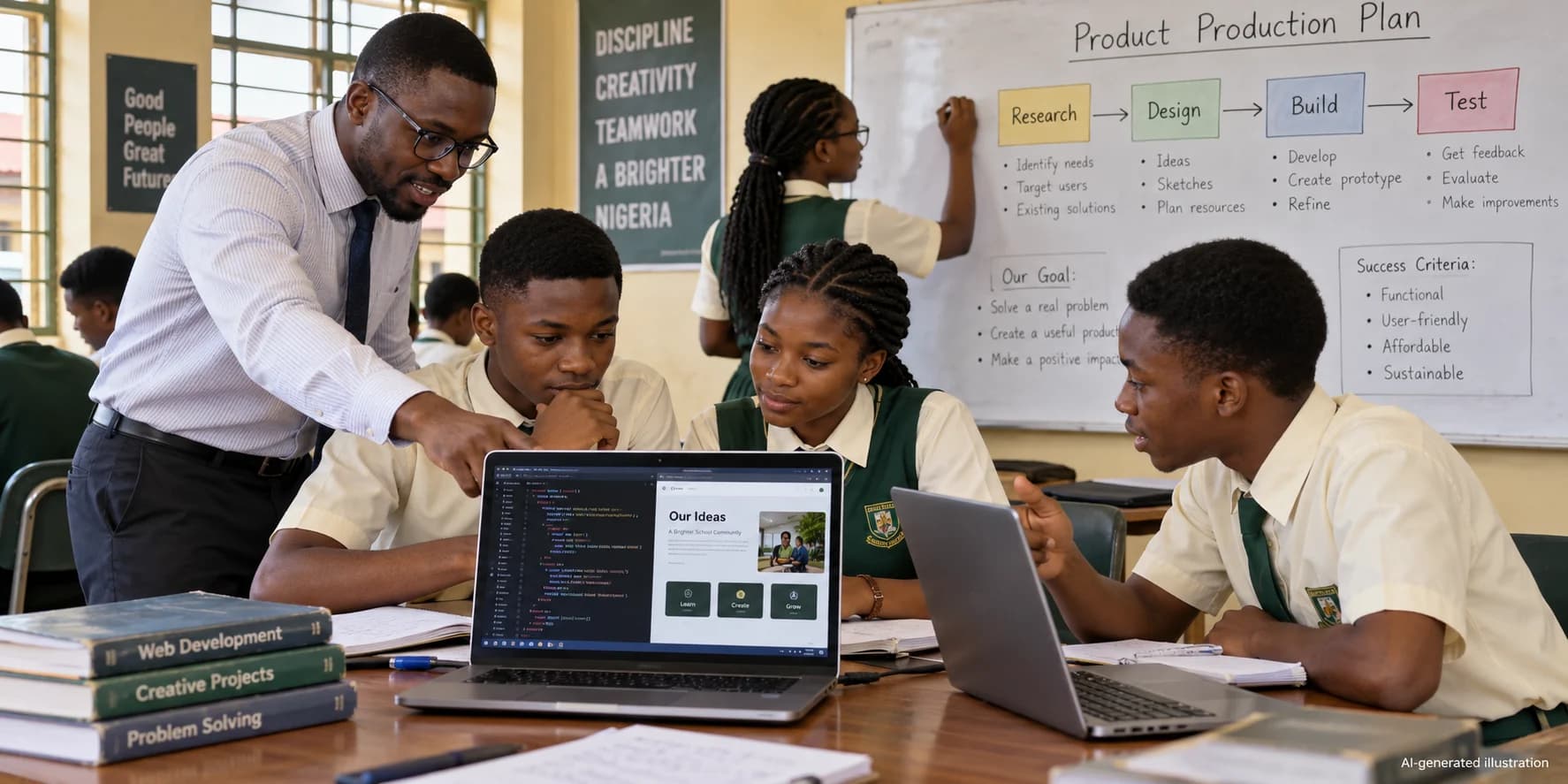
An idea on paper. A first version that did not quite work. A change that made it better. Learning becomes meaningful when students can explain what they tried, what they made and what they would do differently.
Skills with somewhere to go
A foundation in Canva and Figma design, with choices made for a clear purpose.
Organise data in Excel, explore Power BI and create web pages with HTML and CSS.
Digital citizenship continues from primary school. All JSS and SS learners study what AI is, how it is developed and how human judgement guides its use in building useful things. Senior learners explore Nigeria’s Cybercrimes (Prohibition, Prevention, etc.) Act, 2015 and its 2024 amendment.
Builder: websites, software, automations, data tools and prototypes. Storyteller: design, writing, video, branding, media and presentations. Strategist: research, data, business, product thinking, marketing and planning.
See the approach
Explore a simple example of how guidance becomes practice, and practice becomes something a learner can explain.
An illustrative activity
Who will use the page? Sketch its purpose, content and layout in a product plan.
Illustration of the learning journey · not a live dashboard
An illustrative project journey. Teaching follows the programme’s age-appropriate skills; activities and project depth are adapted to the learner group.
The support around the lesson
Around the lesson
Guided demonstrations lead into practice and project work. Activities are adapted to the learner group, with room to ask questions and try again.
Illustration of the learning journey · not a live dashboard
In TechUp partner schools, In-school LaunchPad creates a route for us to identify promising student ideas and explore building an enterprise alongside the student. Intern with Forge offers a separate practical pathway after SSCE. These school benefits are for participating-school learners or public-school learners onboarded through Forge training, whose demonstrated learning fits the opportunity. Each has its own review and arrangements.
Before we begin
TechUp is a subject for all students. JSS1–JSS3 build a shared foundation; SS1–SS3 choose Builder, Storyteller or Strategist. SS1–SS3 track-based live classes run for about three hours on Saturdays through the portal.
Learners use their own gadgets. Without a classroom device, learners can later practise guided dashboard activities on a parent’s device after access is activated. Supplier introductions for used laptops below NGN100,000 depend on availability; suppliers may offer instalments under their terms.
Assignments and project submissions record progress. By SS3, students can download their work and assemble a portfolio for future learning, applications and professional profiles, subject to platform age and eligibility rules. This does not guarantee a job or earnings.
TechUp · one foundation, room to grow
Students explore design with Canva and Figma, organise information in Excel, explore data with Power BI and build web foundations with HTML and CSS. They connect logic, research and communication to small useful projects: a page that organises revision links, for example.
Every learner explores AI: what it is, how people develop it using data and models, and why human judgement matters when checking results and deciding what to build. Digital citizenship includes privacy, respectful communication and recognising online risks.
Students build on those foundations through a track. They plan, make, test and explain their work, with AI understanding and responsible use across all three tracks.
Senior learners also explore Nigeria’s Cybercrimes (Prohibition, Prevention, etc.) Act, 2015 and the 2024 Amendment Act, connecting online choices with responsibility.
Both programmes are 70% practical and 30% theory. The point is to build useful things with the tools and resources available here, and understand the thinking behind the work.
Your school’s next beginning
Onboarding for next term is open through 31 December 2026. This is a subject for all students. We will work through family preparation, practical arrangements and setup with your school.